
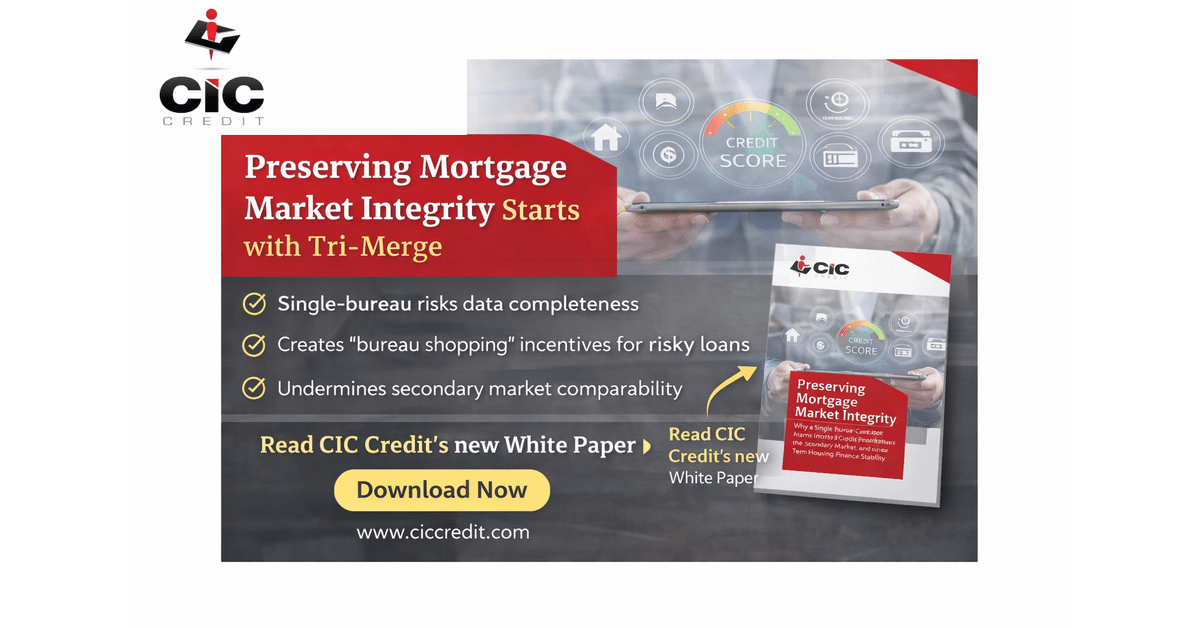
Why Credit Data Integrity Still Starts with Tri-Merge
Mortgage finance is built on one principle that rarely makes headlines: standardization. When originators, aggregators, investors, mortgage insurers, and rating agencies can rely on consistent inputs, the market can price risk efficiently, support liquidity, and keep borrowing costs as low as fundamentals allow.
That is why the mortgage industry’s long-standing tri-merge credit report framework is more than a workflow convention—it is a capital markets stability control.
CIC Credit’s latest white paper examines the growing push to move away from tri-merge—most notably, advocacy for an optional single-bureau credit report approach for certain borrowers (often discussed around an initial score threshold of 700+). The paper explains why this shift is not in the best interest of investors, the secondary market, mortgage insurers, or long-term housing finance stability—even if it appears to reduce upfront origination expenses.
The Core Issue: Credit Bureau Data Isn’t Identical—and Furnishing Isn’t Uniform
The fundamental challenge is structural: credit bureau datasets are not identical, and creditors are not required to furnish tradelines to all bureaus. That means any approach that relies on just one repository increases the probability of missing debt, derogatory history, or even positive history—each of which can distort risk evaluation and pricing.
These are not minor operational details; they are the reason tri-merge exists as a mortgage standard—a hedge against incomplete coverage when furnishing is voluntary and uneven.
What Tri-Merge Actually Does (and Why Investors Depend on It)
Tri-merge is intended to include information from three different credit repositories. It also supports the standardized “representative score” method (commonly understood as the “middle score” convention), which helps dampen outliers and creates comparability across transactions.
For investors and the secondary market, that consistency becomes the foundation for:
- eligibility and pricing stratification,
- pool composition comparisons, and
- back-testing default/severity and credit performance models.
The warning is straightforward: when you weaken the consistency of the underlying credit input, you weaken the integrity of everything built on top of it.
Tri-merge also contains an important safety-and-soundness bias: when duplicate tradeline information is present but not identical, the merged report should reflect the most derogatory duplicate information related to payment history and status.
Why the “Other Consumer Finance Markets Use Single Bureau” Argument Breaks Down
Proponents often point to auto, home equity, and unsecured credit markets as evidence that single-bureau norms can work. CIC Credit explains why this analogy is weak—mortgages are fundamentally different:
- Duration and convexity: mortgages are long-duration assets with embedded prepayment options, where small changes in credit assumptions can materially affect valuation.
- Standardization requirements: agency MBS depends on pooling and disclosure conventions that reward comparability; inconsistent credit inputs erode that.
- Systemic externalities: mortgage underwriting standards propagate through housing markets and taxpayer-adjacent risk frameworks more directly than short-term consumer credit.
- Adverse selection sensitivity: small shifts in score and eligibility bins can drive large changes in execution, pricing, and delivered loan composition.
The Four Risks of a Single-Bureau Option
The white paper consolidates the implications into a clear set of conclusions:
- Data completeness risk increases because furnishers do not report uniformly across all bureaus.
- Adverse selection (“bureau shopping”) incentives emerge—an underwriting analogue to appraisal shopping—potentially inflating delivered credit quality metrics while increasing embedded credit risk.
- Secondary market comparability erodes, forcing investors, aggregators, rating agencies, and MI providers to recalibrate models—and potentially demand risk premiums for uncertainty.
- Pricing volatility increases because scores can vary across repositories due to data differences; tri-merge is designed to reduce the impact of outliers through representative scoring conventions.
The paper also flags an important market reality: changing the reporting foundation can materially shift score outcomes for a meaningful share of borrowers, and that can alter eligibility outcomes at scale.
Risk Layering: Why This Becomes a Repurchase, QC, and Resiliency Problem
Mortgage risk rarely arrives in one clean category. It layers.
A single-bureau model can increase the likelihood of missing debt, which can increase early payment default volatility and QC defect findings. Even if repurchase policies are adjusted, loan performance is not “adjusted,” and downstream markets still price realized risk and uncertainty.
Tri-merge also functions as an operational resiliency tool, reducing dependence on any single repository’s data integrity, match/merge algorithms, outage risk, cyber incident risk, and dispute pipeline lag. In a systemically important market, reducing redundancy is typically penalized—not rewarded—by capital markets.
Modernization Without Degradation: The Better Path Forward
CIC Credit’s position is not “status quo at any cost.” The paper recognizes cost concerns while rejecting the false choice between affordability and data integrity.
A forward-looking reform agenda includes:
- Enhanced disclosures during any transition, enabling the market to compare results and build confidence through comparability periods.
- Direct price transparency reforms, such as clearer pricing schedules, standardized reissue/transfer policies, and controls on bundling practices that obscure what’s actually being paid for.
- Score choice and competition without lowering report quality, paired with guardrails that reduce gaming and adverse selection.
- Preserving tri-merge for final underwriting and delivery, where investor comparability is essential.
CIC Credit’s Call to Action: Lead the Market to “Better,” Not “Less”
The market does not need less data—it needs better governance, better transparency, and smarter implementation.
If you are an investor, aggregator, lender, servicer, or housing finance leader, now is the time to engage—before optionality becomes embedded in market structure. Protecting tri-merge as the baseline for final underwriting and loan delivery is not simply operational best practice; it is a secondary-market integrity imperative.